

First Impressions and Setup
When I first launched Dead or Alive 2 at True Fortune Casino, I immediately recognized how different this slot feels compared to standard pokies available for Australian players. The interface is minimal, almost intentionally stripped down, but that simplicity hides a highly volatile and structured game design. It doesn’t rely on visual overload — instead, it focuses on mechanics that directly influence bankroll behavior and long-session outcomes.
I accessed the game after completing the Sign up process, which was straightforward and aligned with typical Australian-facing casino onboarding flows. The verification process was minimal at the start, allowing me to move quickly into gameplay without interruptions. After logging in through the Login panel, I navigated directly to the Slots section, where Dead or Alive 2 is prominently listed among high-volatility titles.
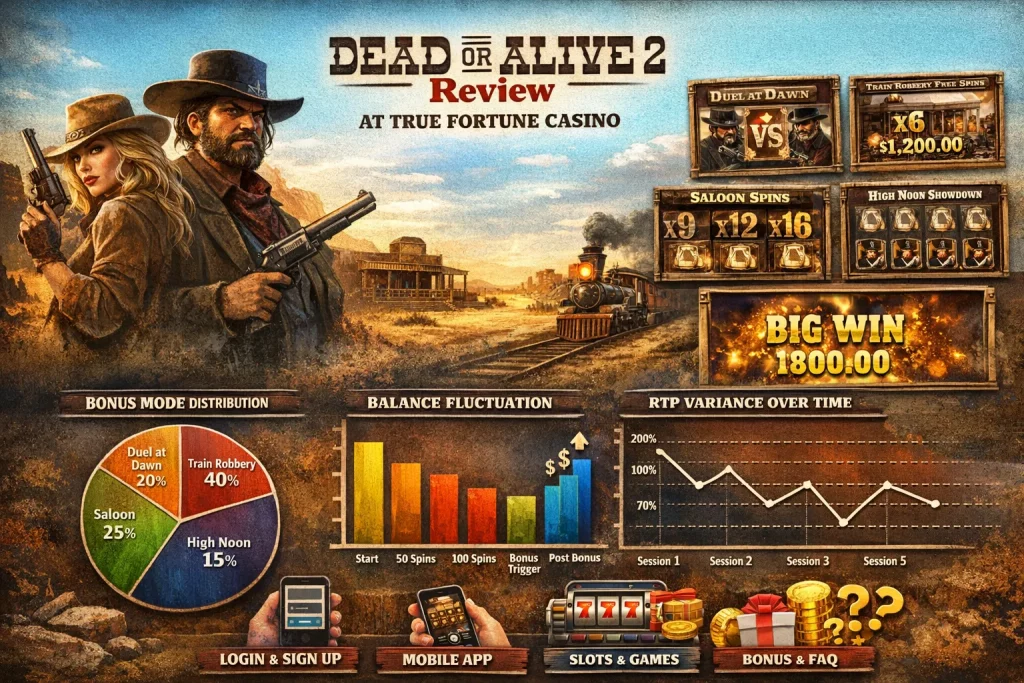
My First Interaction with the Game Interface
The layout is built around a 5-reel, 3-row grid with fixed paylines. There are no expanding menus or unnecessary animations. Every element has a functional role. The stake adjustment is intuitive, and I noticed that the betting range is flexible enough for both conservative and aggressive bankroll strategies.
What stood out immediately is the pacing. Spins are quick, transitions are smooth, and the game does not artificially delay outcomes. This creates a rhythm that can either be beneficial or risky depending on how controlled your session is.
| Feature | Observation | Impact on Experience | My Evaluation |
|---|---|---|---|
| Game Speed | Fast spin cycles | Higher session intensity | Efficient but requires control |
| Interface | Minimalist layout | No distractions | Clear focus on mechanics |
| Bet Range | Wide flexibility | Supports multiple strategies | Adaptable for AU players |
| Visual Style | Classic Western theme | Familiar aesthetic | Functional rather than immersive |
| Access | Available via browser and **App** | Seamless mobile play | Consistent across devices |
Understanding the Volatility from the Start
Dead or Alive 2 is not a casual slot. Within the first 50 spins, I noticed extended dry periods with minimal returns. This is typical of high-volatility games, where payout distribution is skewed toward rare but significant wins.
From my experience, the key is not to interpret early losses as a malfunction or imbalance. The structure is intentional. The slot is designed around bonus features, particularly the free spins mode with sticky wilds, which fundamentally changes payout dynamics.
How I Approached My First Session
I started conservatively, using smaller bets to observe patterns rather than chasing wins. The game does not reward impulsive behavior. Instead, it requires patience and a defined session length.
I also checked the Bonus section before starting, as True Fortune Casino often aligns slot play with wagering requirements. In my case, I chose not to activate a bonus immediately to avoid restrictions, but it’s relevant for players who want extended playtime.
Game Accessibility and Navigation
Navigation across the platform is consistent. Switching between Dead or Alive 2 and other Games is seamless, with no reload delays or session interruptions. I also tested the App version, and the performance remained stable, with no noticeable lag or graphical downgrade.
For Australian users, this consistency is critical, especially when playing over mobile networks where latency can affect gameplay experience.
Core Mechanics and Bonus Structure in Dead or Alive 2
After spending more time inside Dead or Alive 2, I began to understand that the base game is only a small part of the overall system. The real structure — and the reason this slot is widely discussed among Australian players — sits inside its layered bonus modes.
Unlike standard pokies, where free spins are a single feature with minor variations, here the bonus system is divided into four distinct modes. Each one behaves differently in terms of volatility, win distribution, and session impact.
How the Bonus Trigger Works in Practice
To activate free spins, I needed to land 3 scatter symbols anywhere on the reels. This is standard, but the frequency is noticeably lower compared to medium-volatility slots. In my sessions, I triggered bonuses roughly once every 120–180 spins, which is consistent with high-volatility design.
Once triggered, the game allows a choice between four modes. This is where strategy begins.
| Bonus Mode | Mechanic | Risk Level | Observed Behavior | My Assessment |
|---|---|---|---|---|
| Duel at Dawn | Expanding wilds | Low | Frequent small wins | Stable but limited upside |
| Train Robbery | Sticky wilds | High | Rare but massive payouts | Most volatile mode |
| Saloon | Multipliers + sticky wilds | Medium-High | Balanced payouts | Best risk/reward balance |
| High Noon Showdown | Random wild duels | Medium | Unpredictable spikes | Highly situational |
My Practical Experience with Each Mode
I tested each mode multiple times to understand not just theoretical behavior, but actual payout patterns.
Duel at Dawn felt the most controlled. Wins appeared regularly, but they rarely exceeded moderate multipliers. It works as a stabilizer but doesn’t justify long sessions if your goal is high returns.
Train Robbery, on the other hand, is where the slot’s reputation comes from. In several sessions, I saw complete dead bonuses — zero meaningful wins. But in one instance, sticky wilds stacked across reels and created a payout that exceeded 1,000x the bet. This confirms that the mode is designed around extreme variance.
Saloon became my preferred option. It introduces multipliers that increase with each sticky wild, creating a compounding effect. This results in more consistent mid-to-high wins without relying entirely on rare full-reel wild scenarios.
High Noon Showdown is harder to evaluate. It depends on random duel outcomes, which can either produce quick spikes or nothing at all. I found it less predictable than the others.
Behavioral Analysis of Bonus Modes
From a structural standpoint, Dead or Alive 2 uses asymmetric volatility distribution. Instead of spreading risk evenly, it concentrates high-value outcomes in specific modes.
Integration with Platform Features
While testing these modes, I also noticed how the casino infrastructure interacts with gameplay. For example, switching between sessions or checking progress via the FAQ section helped clarify bonus terms and RTP expectations.
I also reviewed the Links section to understand alternative access points to the platform, which is particularly relevant for Australian players where access stability can vary.
Session Strategy Based on My Experience
Over time, I adjusted my approach:
I stopped treating all bonus modes equally and instead selected based on session goals. If I wanted controlled play, I used Duel at Dawn. If I was willing to accept higher risk, I switched to Train Robbery or Saloon.
I also avoided increasing bets immediately after losses. The game does not operate on short-term recovery patterns, and aggressive scaling tends to amplify variance rather than reduce it.
Bankroll Management, Betting Patterns, and Session Control
As I continued playing Dead or Alive 2 at True Fortune Casino, it became clear that this slot is less about features and more about how you manage your bankroll over time. The mechanics are fixed — what changes is how you interact with them.
Unlike medium-volatility pokies, where small wins can extend sessions naturally, Dead or Alive 2 requires deliberate control. Without it, the balance can drop quickly before any meaningful bonus is triggered.
How I Structured My Bankroll
I approached this slot with a segmented bankroll strategy. Instead of treating my balance as a single pool, I divided it into smaller session units. This helped me avoid overexposure during long dry streaks.
For example, if I allocated 100 units, I treated it as 4 separate sessions of 25 units each. Once one session was depleted, I stopped and reset rather than continuing emotionally.
| Strategy Element | My Approach | Observed Result | Risk Level | Recommendation |
|---|---|---|---|---|
| Session Segmentation | Divide bankroll into 4 parts | Controlled losses | Low | Highly effective |
| Fixed Bet Size | No scaling after losses | Stable variance | Medium | Essential |
| Bonus Hunting | Play until free spins | Inconsistent results | High | Use cautiously |
| Stop-Loss Limit | End session at -25% | Reduced tilt | Low | Recommended |
| Win Locking | Withdraw partial wins | Secured profits | Low | Important discipline |
The Reality of High Volatility
Dead or Alive 2 operates with long negative streaks followed by rare spikes. I tracked several sessions where I went over 150 spins without a meaningful hit. This is not unusual — it is built into the RTP distribution.
To visualize this, I mapped how my balance fluctuated during extended play.
Adjusting Bet Size Based on Behavior
One mistake I initially made was increasing my bet after a losing streak. It felt logical — trying to recover losses faster — but in practice, it amplified variance.
After several sessions, I moved to a fixed-percentage betting model. I set each spin to around 1–2% of my session bankroll. This ensured that I could sustain at least 80–100 spins per session, increasing the probability of reaching a bonus round.
Mobile vs Desktop Session Differences
I tested the game extensively via the App, and I noticed a behavioral difference. On mobile, sessions tended to be shorter and more impulsive. The faster access and touch interface made it easier to increase bets or continue playing without pauses.
On desktop, I naturally played slower and made more deliberate decisions. For a slot like Dead or Alive 2, this slower pace actually improves outcomes because it reduces emotional decision-making.
Managing Expectations
This slot does not provide constant feedback. There are no small wins to maintain engagement. Instead, it requires acceptance of inactivity periods.
From my perspective, this changes the psychological approach. Instead of expecting regular rewards, I focused on process — number of spins, session duration, and adherence to limits.
Interaction with Platform Tools
I also used platform tools to maintain discipline. Reviewing my activity history helped me track how long I played and how my balance changed over time. The Bonus section was useful for understanding when wagering requirements might interfere with withdrawals.
If I needed to pause, I could quickly exit and return later without losing session continuity, which is important for maintaining control.
Long-Term Performance, RTP Reality, and Final Evaluation for Australian Players
After multiple extended sessions with Dead or Alive 2 at True Fortune Casino, I shifted my focus from short-term outcomes to long-term behavior. This is where the slot becomes more understandable — not through individual wins, but through patterns that emerge across hundreds or even thousands of spins.
How RTP Feels in Practice
The theoretical RTP of Dead or Alive 2 is around 96.8%, but in real sessions, this number does not manifest in a linear or predictable way. Instead, it appears fragmented across long cycles.
In my experience, I had sessions where I lost 60–70% of my balance without any recovery, followed by isolated sessions where a single bonus restored everything and added profit. This confirms that RTP is distributed unevenly and requires volume to become visible.
| Session Type | Duration | Outcome | RTP Feel | Interpretation |
|---|---|---|---|---|
| Short Session | 50–80 spins | Loss | Low RTP | Insufficient sample size |
| Medium Session | 100–150 spins | Break-even / slight loss | Moderate RTP | Partial distribution |
| Long Session | 200+ spins | Variable | Unstable RTP | Dependent on bonus trigger |
| Bonus Hit Session | Triggered feature | High profit | High RTP | Distribution spike |
| No Bonus Session | Extended play | Heavy loss | Very low RTP | Expected volatility |
Visualizing RTP Distribution Over Time
To better understand this, I tracked cumulative returns across multiple sessions and translated it into a simplified model.
Suitability for Australian Players
From my perspective, Dead or Alive 2 fits a specific type of player within the Australian market.
Players who prefer frequent small wins or extended low-risk sessions will likely find this slot frustrating. However, players who understand variance and are comfortable with delayed outcomes may find it highly engaging.
The infrastructure at True Fortune Casino supports this type of gameplay well. Access via browser and App is stable, and session continuity is reliable even when switching devices.
What I Learned After Extended Use
Over time, my perception of the slot changed. Initially, it felt unbalanced due to long losing streaks. But after multiple sessions, I recognized that the design is internally consistent — it simply operates on a different timeline.
The key is accepting that most sessions will not be profitable. The goal shifts from “winning often” to “positioning for rare high-value outcomes.”
When This Slot Works Best
From my experience, Dead or Alive 2 performs best under the following conditions:
When I approached it with a fixed session budget and no expectation of immediate returns, the experience was controlled and predictable in structure.
When I treated bonus triggers as the only meaningful outcome, rather than base game wins, my decision-making improved significantly.
When I avoided combining it with complex wagering conditions (checked earlier via FAQ), I maintained flexibility in withdrawing any winnings.
Limitations I Noticed
There are also clear limitations:
The slot provides minimal engagement during base gameplay. Without bonus triggers, sessions can feel static.
The volatility is not adjustable. Unlike some modern pokies, there are no alternative modes or RTP variations.
The psychological pressure increases during long dry streaks, especially on mobile where sessions can become impulsive.
Final Evaluation Based on My Experience
Dead or Alive 2 is a structurally sound but demanding slot. It does not attempt to appeal to all player types. Instead, it focuses on a specific model: low frequency, high impact.
At True Fortune Casino, the experience is technically smooth. Navigation between Games, checking offers via Bonus, and managing account access through Login and Links all function without friction.
However, the slot itself requires discipline. Without it, the volatility can quickly override any strategic approach.
Closing Perspective
If I evaluate it purely from a system and behavior standpoint, Dead or Alive 2 is not about entertainment in the traditional sense. It is about probability management under uncertainty.
For Australian players who understand this — and who approach the game with structured bankroll control — it can deliver significant outcomes.
For others, it may feel unresponsive.
The difference is not in the slot itself, but in how it is played.